Your assets
What a Safe holds, read from the chain, merged across chains, and priced only where the price can be stood behind.
What it does
When you import a Safe, the app finds every token it holds on each chain Tamias supports, then reads the amounts from the chain itself. Tokens on a verified list are priced and added up into one portfolio value. Everything else the Safe holds is still shown, in a folded list of its own, and never priced.
Finding the tokens and reading them are two different steps. A data provider tells the app which token contracts to look at. The amounts never come from it: every balance is read directly from the chain. When the provider is unavailable, the app walks the Safe's history block by block instead, which is slower but finds the same tokens. After that, new tokens are picked up as they arrive.
What could go wrong without it
Anyone can send a token to any address. A Safe collects airdropped tokens, worthless ones and fakes that borrow a real token's name. Priced naively, a treasury total counts them, and a token called USDC at the wrong address looks exactly like the real one in a list you can send from.
What you see in the app
Balances. The Safe page shows the portfolio value and a list of the verified assets, one row per asset: amount, price with its 24-hour move, value, and share of the total. An asset held on several chains is one row, with small chain marks beside its symbol. Open the arrow on the row to see how much sits on each chain. Above the list, one card per chain narrows the list to that chain. It starts on All chains.
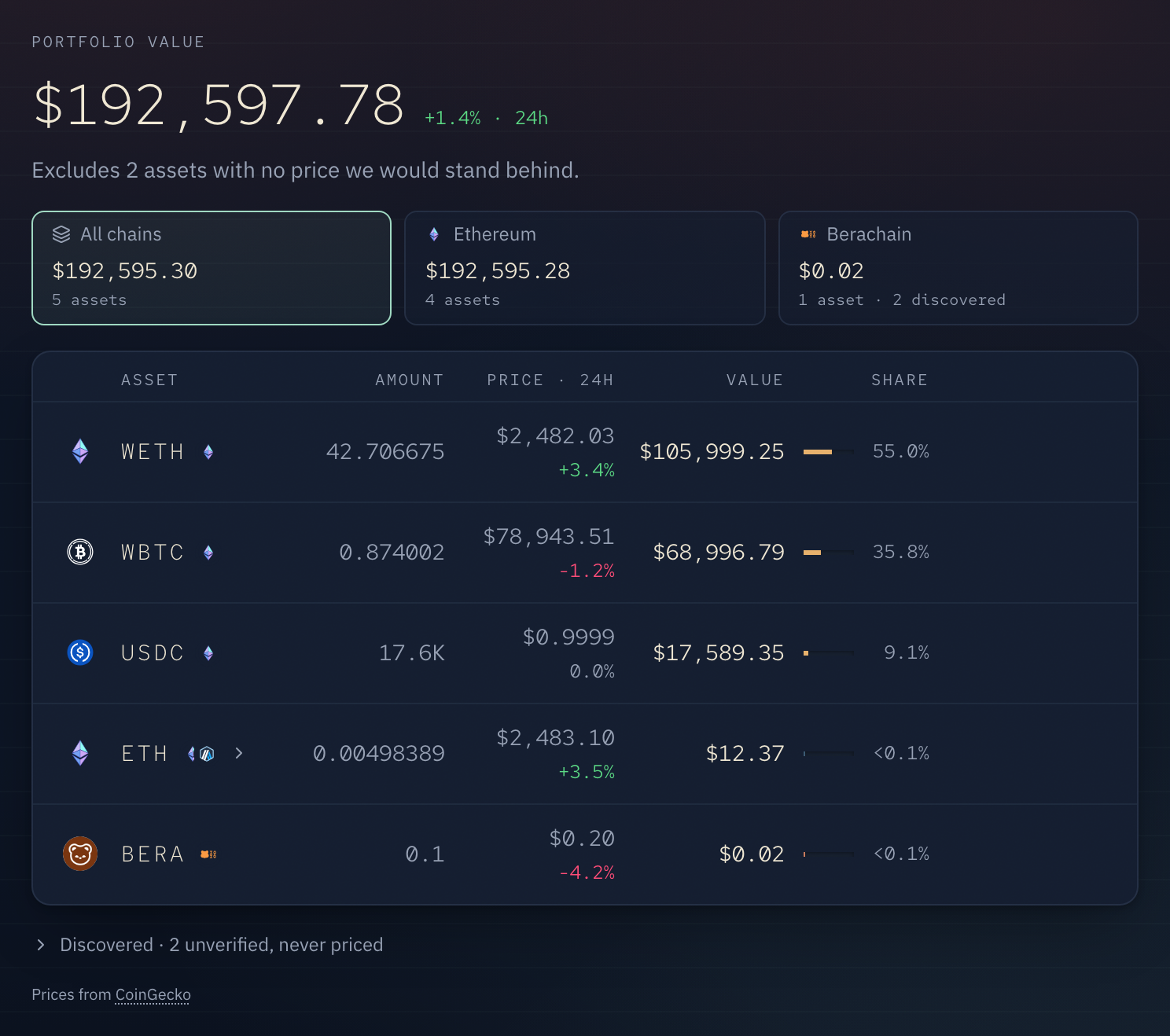
A verified asset the price feed has no price for shows "—" for price, value and share, and the line under the total says how many assets it leaves out.
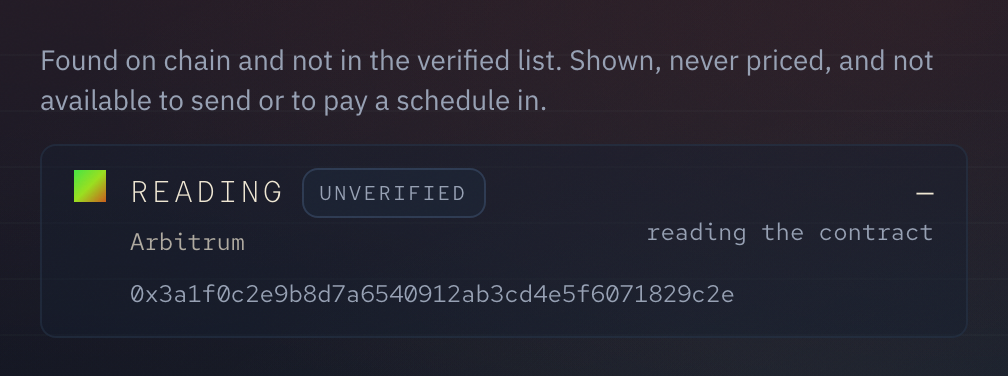
Discovered tokens. Everything not on the verified list sits under "Discovered · N unverified, never priced". Open it to see each token with an "unverified" tag. Tokens the Safe never transacted for, and tokens that use a verified token's ticker at a different address, fold again under "N tokens nobody asked for". An impersonator is tagged "claims USDC" (or whichever ticker it copies) and warns that it is a different contract to the one this Safe can send.
While a token is being read. A newly found token may show "READING" in place of its symbol, with "—" and "reading the contract" in place of its amount. The app has not yet asked the token for its name and its number of decimals, and it will not guess them. It fills in on its own, usually within minutes. A token that refuses to answer shows "UNNAMED" or "amount unreadable" and stays that way.
Base units. In the Positions section, a line about money that went into or out of a protocol may show a long whole number and a short contract address, such as "2,000,000,000 0xaf88…5831 in". That is the raw amount in the token's smallest unit, shown because the token's decimals could not be read yet. It turns into a normal amount once they are. A wrong decimal count would be a wrong amount, so the app shows the raw number instead.
What it does not do
You cannot add a token or mark one as verified from the app, and you cannot hide one. The verified list is kept by us, checked against a block explorer.
A discovered token is never priced, never counted in the total, and cannot be sent or used to pay a schedule. NFTs are counted, not valued.
Balances only cover the chains Tamias supports today: Ethereum, Arbitrum, Base, Berachain and Robinhood Chain.